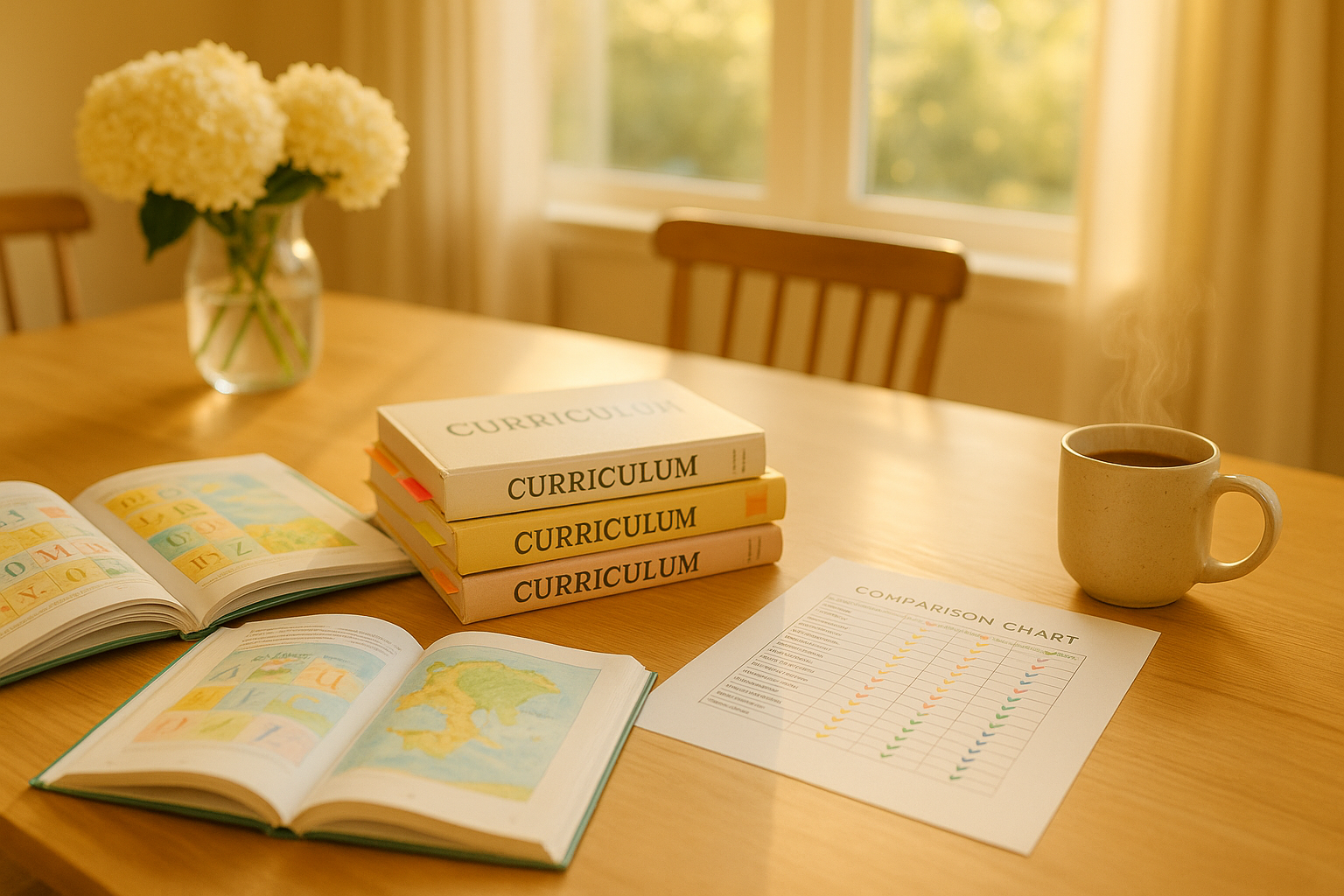
Walk into any homeschool curriculum fair and you'll be confronted with dozens of publishers, hundreds of products, and thousands of opinions. Everyone swears by their approach. Saxon Math families and Teaching Textbooks families argue like Red Sox and Yankees fans. The Sonlight crowd looks down on textbooks. The Abeka crowd thinks unschooling is neglect.
Here's the truth: the best homeschool curriculum is the one your child will actually use. There is no universally superior choice. But there are significantly better and worse fits for different ages, learning styles, and family situations. This guide gives you honest, grade-by-grade recommendations — including real pros and cons most review sites won't tell you.
 Finding the right curriculum isn't about spending the most — it's about finding what fits.
Get a personalized recommendation in 3 minutes
Answer a few questions about your child's learning style, grade, and your family's goals. NestEd's Curriculum Matcher gives honest picks — no sponsors, no affiliate commissions driving the results.
Try the Curriculum Matcher →Elementary Curriculum Recommendations
The elementary years are about building the foundation: reading fluency, math facts, writing mechanics, and a love of learning. The biggest mistake parents make at this stage is over-complicating it. Young children don't need a $2,000 curriculum package. They need consistent daily instruction, good books, and time to play.
That said, a reliable structure helps tremendously in the first year when you're still figuring out the rhythm. Here's what works:
Math: Grades K–5
Saxon Math (K–5)
$90–$120/levelThe most widely used homeschool math curriculum for a reason. Saxon uses incremental development and distributed practice — new concepts are introduced slowly, and every lesson reviews previously learned material. Students who finish Saxon K–5 have extremely solid arithmetic foundations.
- Proven track record over 30+ years
- Strong review keeps skills sharp
- Parent-friendly scripted lessons
- Holds resale value well
- Can feel repetitive for fast learners
- Heavy on drill, light on conceptual depth
- Spiral approach frustrates some kids
- Needs supplementation for word problems
Math-U-See (K–Pre-Algebra)
$70–$140/levelHands-on, manipulative-based math built around a mastery approach. Each level focuses on one concept until the student truly understands it before moving on. Particularly strong for visual and tactile learners. The manipulative blocks are reusable across all levels.
- Excellent for visual/kinesthetic learners
- Mastery approach builds real understanding
- Video instruction takes teaching pressure off parents
- Blocks are reusable for multiple children
- Mastery pacing can create gaps if not careful
- Less review than Saxon
- Manipulatives add upfront cost
Khan Academy (K–12)
FreeThe best free math resource ever created. Not a complete curriculum on its own at the elementary level (it lacks the structured lesson progressions and parent tools that younger learners need), but extraordinary as a supplement or for self-directed older students. Use it to fill gaps, provide extra practice, or as a primary curriculum from grades 6+ when students can work more independently.
- Completely free, no catch
- Excellent video explanations
- Adaptive practice adjusts to level
- Parent dashboard tracks progress
- Requires student self-direction
- No physical workbooks for young children
- Less effective as sole curriculum for K–3
Language Arts: Grades K–5
All About Reading + All About Spelling
$100–$130/levelThe gold standard for phonics-based reading and spelling instruction. Both programs use Orton-Gillingham methodology — structured, sequential, multi-sensory — which research consistently shows is the most effective approach for teaching reading, especially for students who struggle. Even typical learners benefit from the systematic approach.
- Research-backed methodology
- Highly effective for struggling readers
- Multi-sensory, hands-on lessons
- Clear, easy-to-follow teacher guide
- Requires parent involvement for each lesson
- Can feel slow for strong early readers
- AAR and AAS are separate purchases
The Good and the Beautiful (K–8)
Free PDFs / $30–$60 printedA Charlotte Mason-inspired language arts curriculum that integrates reading, writing, grammar, and literature. Beautifully designed, literature-rich, and notably more affordable than most competitors. The core sets are available as free PDFs — you can print them or buy the physical books affordably. A sleeper hit that deserves more attention.
- Free or very low cost
- Beautiful, engaging design
- Integrates literature with grammar
- Strong read-aloud component
- Lighter on phonics than All About Reading
- Faith-based content (some secular families prefer alternatives)
Not sure which elementary curriculum fits?
Tell us your child's age, learning style, and whether they're just starting or continuing — NestEd's Matcher gives you a specific recommendation with honest reasoning.
Get My Elementary Recommendation →Middle School Curriculum Recommendations
Middle school is where homeschooling gets more interesting — and more complex. Your student can handle longer work sessions, more independence, and deeper subject matter. This is also when subject-specific curricula become more important, because the gap between a strong and weak math or writing foundation starts to show up clearly in the work.
The middle school years are also when many families shift from an all-in-one curriculum to a subject-by-subject approach, mixing different publishers for math, language arts, history, and science.
Math: Grades 6–8
Teaching Textbooks (6–Pre-Calculus)
$67/year (subscription)Teaching Textbooks has become the dominant math curriculum for middle and high school homeschoolers, and for good reason. It's fully digital, self-teaching (students watch video explanations and work through problems on their own), auto-graded, and genuinely effective. The biggest advantage: it frees parents from teaching math they may not remember well.
- Student teaches themselves via video
- Auto-graded with detailed explanations
- Low parent involvement required
- Affordable subscription model
- Works on any device
- Slightly behind grade level vs. traditional school
- Less rigorous than Saxon for college prep
- Subscription means no resale value
Saxon Math 7/6, 8/7, Algebra 1/2
$75–$130/levelSaxon continues its incremental, spiral approach through middle school. If your student has been using Saxon in elementary, continuation is natural. The 7/6 and 8/7 levels bridge elementary math to pre-algebra effectively. For college-bound students who plan to take calculus, Saxon's rigor pays off in high school.
- Rigorous preparation for advanced math
- Strong cumulative review
- Well-suited for college-bound students
- Dense and dry — requires motivated students
- Parent may need to re-learn the material
- Homework load is heavier than alternatives
Writing & Language Arts: Grades 6–8
Institute for Excellence in Writing (IEW)
$80–$200/unitIEW is the most widely recommended writing curriculum for homeschoolers, particularly families using a classical or traditional approach. It teaches a structured method for organizing and writing any type of essay or report. The method is formulaic at first (intentionally so) — students learn the structure, then learn to vary and expand it. Results are strong.
- Clear, teachable writing method
- Works for reluctant writers
- Strong essay structure foundation
- Video instruction available
- Formulaic approach frustrates creative writers
- Expensive; co-op classes can reduce cost
- Takes time for the method to feel natural
History & Science: Grades 6–8
Sonlight (History/Literature-based, K–12)
$300–$600/yearSonlight's approach to history and social studies is genuinely excellent: rather than a dry textbook, students read primary sources, historical fiction, and living books alongside their history spine. The curriculum comes as a complete instructor guide with a 4-day-per-week schedule all laid out. Higher cost, but high quality — and it holds resale value well.
- Rich, literature-based approach builds genuine interest
- Complete instructor guides reduce planning
- Excellent resale value
- Works across multiple ages simultaneously
- Premium price point
- Large book lists require library access or budget
- Heavy read-aloud component requires parent time
Middle schooler with specific needs?
Whether they're a reluctant writer, a math whiz, or a kid who loves science but hates history — the Curriculum Matcher gives you tailored picks for where they actually are.
Find Middle School Curriculum →High School Curriculum Recommendations
High school is where the stakes rise. Students are building transcripts, potentially preparing for standardized tests (SAT/ACT), and in some cases pursuing dual enrollment at community colleges. The good news: high school is also where many students become far more self-directed, which means you can hand off much of the teaching to quality curriculum and online courses.
A key principle for homeschool high school: match rigor to the student's trajectory. A student heading to a competitive university needs a different curriculum than one pursuing a trade, military service, or entrepreneurship. Don't over-engineer it — or under-prepare them.
Math: Grades 9–12
Teaching Textbooks (Algebra 1 through Pre-Calculus)
$67/year (subscription)Teaching Textbooks remains the most popular choice through high school. The self-teaching format works even better for high schoolers who can work independently for longer stretches. One important caveat: Teaching Textbooks Algebra 2 and Pre-Calculus are slightly less rigorous than comparable Saxon or AoPS levels — this matters if your student plans to study STEM at a competitive university.
- Fully self-teaching for independent students
- Affordable; good for multiple children
- Strong through Geometry and Algebra 2
- Not ideal for future STEM majors beyond Algebra 2
- Pre-Calculus level may need supplementation for SAT
Art of Problem Solving (AoPS)
$70–$150/book or online classesAoPS is the gold standard for mathematically talented students. It's significantly harder than any other homeschool math curriculum and prepares students for AMC/AIME competitions and college-level math. Not for everyone — but for students with genuine mathematical ability who want to study STEM, there is no better option.
- Exceptionally rigorous
- Strong preparation for STEM university programs
- Online courses available with community
- Problem-solving focus builds real mathematical thinking
- Very challenging — not appropriate for average learners
- Requires significant student motivation
- Online classes are expensive
English & Writing: Grades 9–12
Lightning Literature & Composition (Hewitt Homeschooling)
$60–$100/yearOne of the best values in high school English. Each level combines literature study (classic works like Shakespeare, Dickens, Austen) with structured composition instruction. Assignments are rigorous enough for college prep and manageable enough for a parent-taught environment. Levels 7–12 cover classic and world literature chronologically.
- Excellent value for quality
- Genuine literary analysis
- Strong college-prep writing component
- Less name recognition on transcripts than Abeka
- Requires motivated readers
Science: Grades 9–12
Apologia Science (9–12)
$90–$150/courseApologia is the dominant homeschool high school science curriculum. Biology, Chemistry, and Physics courses are well-written, rigorous, and widely accepted by colleges as legitimate high school credits. The books are written in a conversational "talking to you" style that students find engaging compared to dry textbooks. Labs are manageable at home with basic equipment.
- Widely accepted by colleges
- Rigorous enough for pre-med/STEM tracks
- Manageable home labs
- Conversational writing style
- Faith-based content (young earth perspective); secular families may prefer alternatives
- Lab equipment can add cost
Preparing your high schooler for college?
Not sure if your curriculum is rigorous enough for their target schools — or if you're over-complicating it? The Curriculum Matcher factors in your student's goals and gives you a realistic recommendation.
Get My High School Picks →How to Choose: A Practical Framework
After this many options, it's easy to feel more overwhelmed than when you started. Here's a simple framework to cut through it:
- Start with your child's learning style, not reviews. A kinesthetic learner who hates worksheets will fail with even the highest-rated workbook curriculum. A self-directed reader will thrive with almost anything. Know your kid first.
- Match scope to your capacity. A packaged all-in-one curriculum costs more but saves enormous planning time. An eclectic approach is cheaper and more customizable but requires you to be the curriculum director. Be honest about your bandwidth.
- Buy used for the first round. Spend $40–$80 on a used level of whatever curriculum you're considering before committing to a full year. Facebook Marketplace, AbeBooks, and homeschool curriculum swap groups are your friends.
- Trial for 6–8 weeks before judging. All new curricula have an adjustment period. Don't ditch something after two weeks of resistance — give it a genuine trial. Then trust your assessment.
- Use the free stuff more than you think you should. Khan Academy, Librivox, Project Gutenberg, your library's digital resources — these are genuinely excellent. Pride yourself on being resourceful, not on how much you spent.
One more thing before you buy: check your state's requirements
Some states specify required subjects or mandate certain record-keeping. Make sure any curriculum you choose covers what your state actually requires — it takes 30 seconds to check.
Check Your State Requirements →Budget Breakdown: Free, Mid-Range, and Premium
Here's a realistic annual curriculum budget across three tiers, for a single child:
| Tier | Annual Cost | What You Get | Best For |
|---|---|---|---|
| Free / Low-Cost | $0–$200 | Khan Academy (math), library books, free printables, Librivox, CK-12, YouTube | Resourceful families; older self-directed students; supplemental use |
| Mid-Range | $300–$700 | One or two core curricula (e.g., Teaching Textbooks + All About Reading), supplemented with free resources | Most homeschool families; good balance of quality and cost |
| Premium | $800–$2,500 | Complete packaged curriculum (Sonlight, Abeka, My Father's World), or multiple high-quality subject curricula | Families who want everything planned; first-year homeschoolers who want structure |
One cost-saving strategy many families overlook: co-ops. Homeschool co-ops often offer classes taught by parent volunteers or contracted teachers for $100–$300 per semester — dramatically cheaper than buying curriculum and teaching the subject yourself, especially for high school sciences and foreign languages.
 The best curriculum is the one that brings your family together around learning.
Frequently Asked Questions
What is the best homeschool curriculum overall?
There is no universally best curriculum — it depends on your child's age, learning style, and your family's goals. For structured learners, Abeka or Saxon are proven. For literature-rich learning, Sonlight is excellent. For families wanting flexibility and low cost, an eclectic mix of Teaching Textbooks (math) + All About Reading + Khan Academy covers the essentials well. Use NestEd's Curriculum Matcher for a personalized recommendation based on your specific situation.
How much does a complete homeschool curriculum cost?
Costs range from free (Khan Academy + library books) to $200–$500 per year for a single-subject curriculum, to $1,200–$2,500 per year for a complete all-in-one package. Most families spend $400–$900 per child annually using a mix of paid and free resources. Buying used reduces costs by 40–60% for most physical curricula.
Is Saxon Math the best math curriculum for homeschoolers?
Saxon is excellent for systematic learners who benefit from consistent review. It produces strong results and is one of the most widely used homeschool math programs. However, Teaching Textbooks works better for independent learners and busy parents, and Math-U-See is better for visual or hands-on learners. The best math curriculum is the one your child will use consistently — match the style to the student, not the reputation.
What curriculum do most homeschoolers use?
According to homeschool surveys, the most commonly used curricula are: Saxon Math, All About Reading/All About Spelling, Sonlight, Abeka, and Khan Academy. Most families use an eclectic mix rather than a single all-in-one publisher — picking the best fit for each subject rather than committing to one company for everything.
Can I switch curricula mid-year?
Yes, and you should if something clearly isn't working after a genuine 6–8 week trial. Switching mid-year is one of the key advantages of homeschooling — you're not locked into a school's adoption decision. Buy used when possible so switching is less costly. When you switch, start the new curriculum from a point slightly behind where you think your student is, to ensure solid footing before moving forward.
Do I need to follow my state's curriculum standards?
In most states, you have broad freedom to choose any curriculum. However, some states require you to cover specific subjects (math, English, science, social studies, etc.) or maintain subject logs. NestEd's State Compliance Checker shows exactly what your state requires in plain English — so you can confirm your chosen curriculum meets the standard before you buy.
Find the right curriculum for your child
Answer a few questions about your child's grade, learning style, and your family's goals. NestEd gives you honest, personalized recommendations — no sponsors, no ads influencing the results.